
2022 promises to be an eventful year for the construction sector. From the introduction of RE2020 to materials shortages, via EPR and the digitalisation of the sector and its audiences, construction brands will face numerous challenges, both operationally and in terms of communication. How best to prepare for these changes?
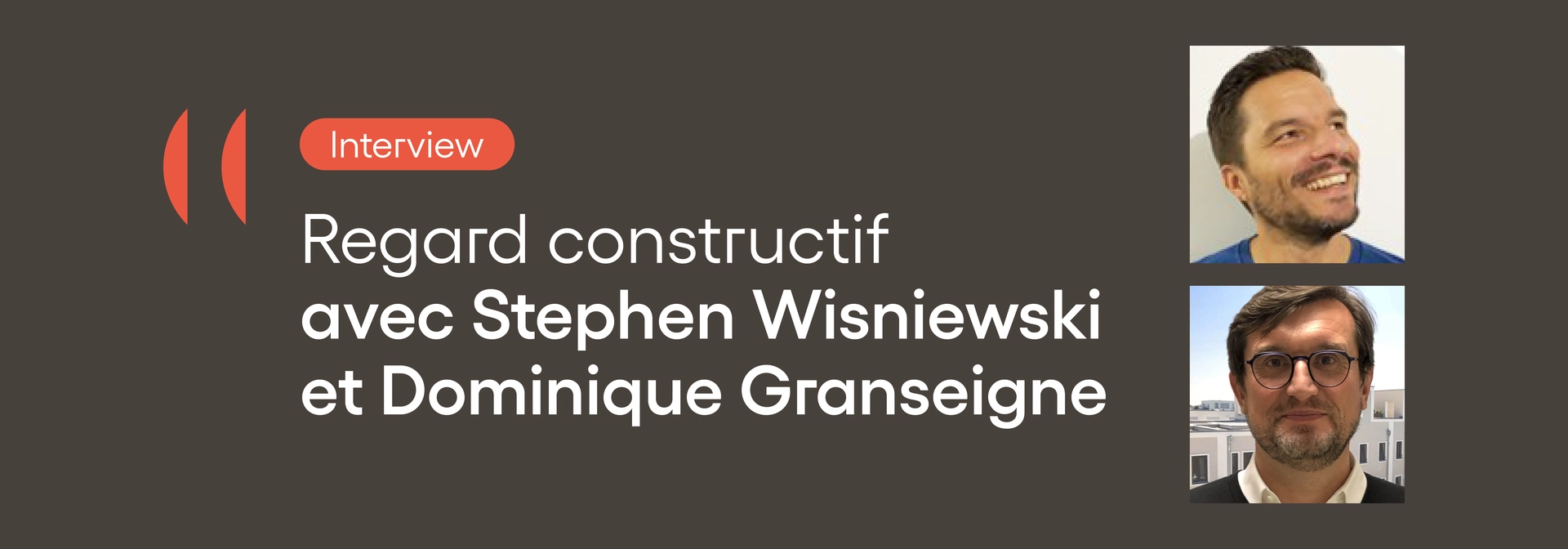
Stephen Wisniewski, Communication & Operational Marketing Manager, and Dominique Granseigne, Sales & Marketing Director, orchestrate communication at XELLA, a manufacturer of building materials and aircrete solutions with five brands: Ytong, Siporex, Silka, Hebel and Multipor. They shed light on how they are approaching this new year and its communication challenges, and on the importance of having the right partner for your strategy.
It is becoming harder to exist digitally amid a multitude of messages. We try to keep a presence in the field and talk with our customers one-to-one.
What are the communication topics you have identified for XELLA and the construction and housing industry as a whole in 2022?
Dominique Granseigne
The first topic is inevitably RE2020 and the idea of “sustainability”. It brings in the notion of carbon, a very important aspect for building manufacturers. Staying on the regulatory front, the second topic concerns the introduction, by early 2023, of EPR (Extended Producer Responsibility) linked to materials recycling. Even though its implementation, initially scheduled for 1st January 2022, has been postponed, it remains a central topic in our discussions. We have thus pre-registered with ECOMINERO, one of the four eco-organisations applying for accreditation in France. Recyclability and the environment, which flow from RE2020 and EPR, will also be central themes in 2022.
The other topics are the shortage of raw materials and the sharp rise in their costs. There is a lack of visibility over the purchase price of raw materials and energy in the coming months. It is now difficult to forecast our budget or give our customers reliable information. This has a knock-on effect on their own end customers, to whom they cannot make commitments. At present we can only hold prices for two months. That represents a major change for a sector that used to quote annual prices.
Finally, the digitalisation driven by COVID forced us to adapt and change working habits, but it has also brought us new opportunities and made exchanges easier.
Stephen Wisniewski
From a product standpoint, renovation is also an important topic. It is a field of application we address notably through Siporex, but it concerns our entire product range. When I talk about renovation, I mean it in the broad sense: from interior renovation to converting office buildings into residential housing. We work on many projects of this kind, particularly in the Paris region and in large cities. Our solution, thanks to its light weight and thermal performance, allows us to position ourselves in specific markets, both in terms of building conversion and interior renovation (extensions or vertical additions to houses, buildings, etc.). The way cities are evolving is pushing us to reinvent ourselves and create new space for new places to live. Our products can meet these new challenges, so this will be a major communication focus in the year ahead. We have already started communicating on this subject with the help of Convergence.
What are the communication challenges associated with all the topics you have just mentioned?
Stephen Wisniewski
Purely in terms of communication, one of the problems we face is the sheer flood of information. Today, everyone is trying to come out on top and wants to carry a message that claims to be neutral but always carries a commercial undertone designed to promote their products. We are all navigating — merchants and professionals alike — an ocean of digital information that can leave us disoriented. One topic drives out another, and it becomes difficult to get messages across when they do not match our customers' current preoccupations, even when they are relevant and important. So we have to repeat the message and adapt by building closeness with our customers.
As Dominique was saying, the “all-digital” approach that developed with the COVID crisis has its advantages but also its drawbacks. Today, everyone is offering webinars and communicating on social media. There is far less real contact, and it is therefore becoming harder to exist digitally amid a multitude of messages. So we try to keep a presence in the field and talk with our customers “one to one”.
Given all these challenges around RE2020 and the questions it raises about sustainable construction, do you think there is a risk of communication tipping over into “greenwashing”?
Dominique Granseigne
The problem we identify with RE2020 has more to do with the influence of excessive communication in favour of sustainability, which can push things to extremes. Of course, this legislation is a very good thing, because it pushes manufacturers to improve, but the solutions being promoted are not always the most appropriate from an environmental standpoint. We see this in particular with those who would like 100% timber construction, without taking into account France's building culture and the long-term durability of concrete. It is important to take account of current construction methods and seek to improve them. For example, we have invested 1 million euros in France to crush all our waste on site, thereby avoiding sending it to Germany by lorry as we did previously. That means 500 fewer lorries on the road every year and 100% of waste reused, with 40% reinvested in manufacturing our products and 60% sold on.
The most important thing is to avoid setting people and solutions against each other. Even if the objective of RE2020 is a good one — we all agree on that — we need to strike the right balance so that construction remains a driving force in France while becoming greener. As we say in France, when construction thrives, everything thrives.
How do you communicate in an uncertain context, as is currently the case with materials shortages and unpredictable costs?
Stephen Wisniewski
We were relatively unaffected by this shortage. So we focused our communication on the fact that our natural, mineral-based materials, produced in France with raw materials sourced nearby, were available — unlike others who bore the full brunt of this unpredictable context.
Our communication was directed more internally, to seize the opportunity we had of being able to deliver our products and make them available. It was positive communication, not crisis communication. Even though we were not hit by the raw materials shortage, we know that in this kind of context it is important to be able to reassure stakeholders and anticipate the situation, both internally and externally.
What are your communication strategies at XELLA, and what are the benefits of being supported by an agency specialising in the construction sector?
Dominique Granseigne
Working with Convergence makes a real difference for us on the various topics that concern us as a construction manufacturer. They are specialists in these themes, which they handle with all their clients. We don't need to train them — they already know the market. So we understand each other more easily, and that allows us to implement actions more quickly. They also have an outside perspective on the market as a whole, thanks to their partners across different sectors and companies. They can advise us with full knowledge of the facts.
Stephen Wisniewski
That market knowledge is indeed very important. From a more operational standpoint, there is real consistency and complementarity across Convergence's teams, despite the distance. They take ownership of projects and offer a 360-degree view. On top of the “communication strategy” side, Convergence also delivers operational marketing roll-out.
Even though we are manufacturers and part of a large group, at the French level we remain an SME, so we need responsiveness and people who know our business. With Convergence, we don't just produce beautiful work — we also consider the results and how to deploy this communication to win over our teams and our customers.

A project, an idea, or simply keen to get to know each other?
Our account directors are here to listen and take time to talk with you
Dominique Granseigne
This was our first year with Convergence and I feel that the work we did together, and the efficiency and spirit they brought to the relaunch of Siporex, suit us perfectly. For a first collaboration, it is a real success. The concept they proposed won me over straight away. They understood us quickly, and that is much appreciated.