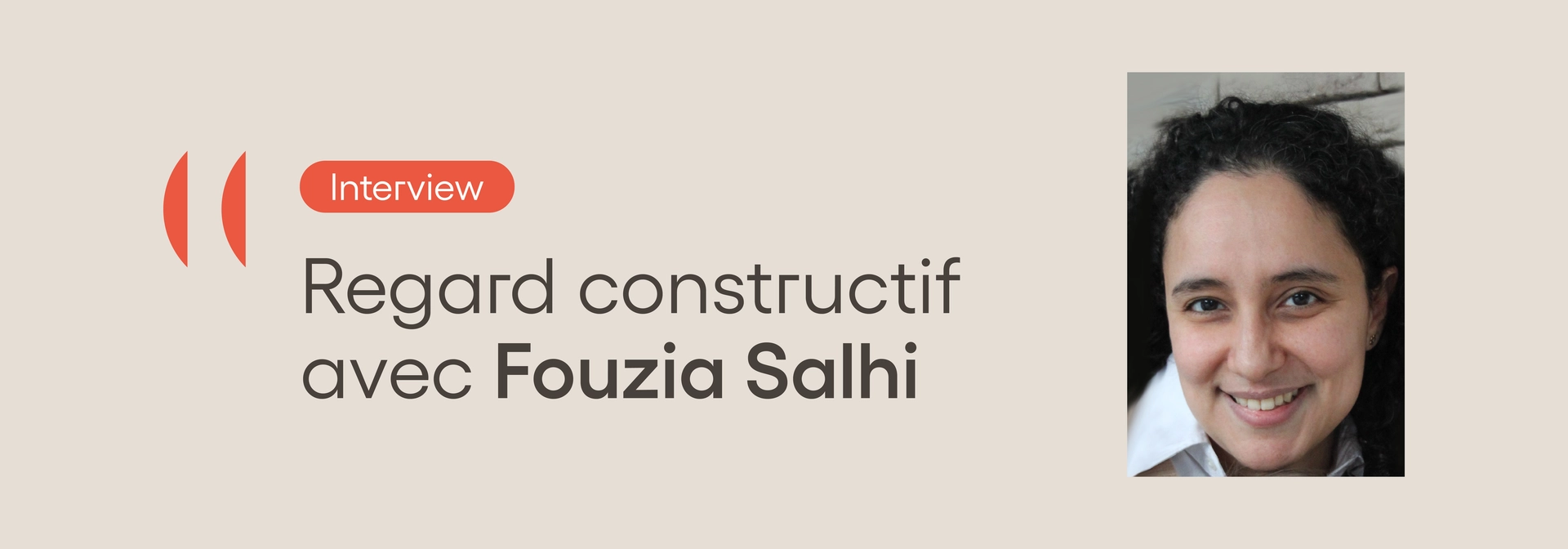

With the construction industry facing unprecedented upheavals such as inflation, the slowdown in the new-build market and material shortages, manufacturers find themselves compelled to adapt their communication strategies. Fouzia Salhi, Marketing Director France at BMI, lifts the lid on the major challenges the group is working through. Dive into her reflections and discover her suggestions for coming through this turbulent period relatively unscathed.
When the weather turns rough, you need to be as clear and transparent as possible with your customers, and avoid hiding behind clumsy explanations.
What is your view on how to orchestrate the marketing and communication of a construction brand in 2023?
The watchword at BMI is restraint. I have been working in the construction industry for many years and I have seen almost every phase. We have now reached a point where we receive an enormous amount of communication and it is becoming increasingly difficult to make sense of it all. That is why we choose to communicate only when we have a relevant topic likely to interest our audiences.
Construction professionals are going through a difficult period, with issues around product availability, price rises and project delays. The idea is not to drown them in a constant stream of information but to make their daily lives easier. Hence the importance of standing out by being the brand that communicates only when it genuinely matters to capture its audiences' attention. I want our customers to think, "Oh, a newsletter from BMI — this must be important." In short, it is about "saying less, but saying it better".
What does your day-to-day look like as Marketing Director France for the BMI group? What difficulties do you encounter and what certainties do you rely on?
BMI is a relatively recent construct, born of the acquisition by an American manufacturer of the companies Braas Monier and Icopal. The two brands merged to become BMI. The first difficulty stems from the dichotomy between a very strong heritage — employees who have been invested and committed to these two companies for many years — and a certain youthfulness, given that the BMI group was created only 6 years ago. In communication terms, that presents some wonderful challenges: we share a common territory, the roof, but everything else is disparate — the product categories, the customers and the business models are all different. So our goal is to bring it all together, to succeed in creating a beautiful melody from different families of instruments.
Fortunately, I can rely on a very strong marketing and communication team that is deeply committed to the BMI project. We do everything we can to make that music harmonious, with as few false notes as possible.
What are the main communication topics or challenges you have identified for BMI since you arrived?
One challenge ties in with what I was saying earlier: the idea of exercising restraint and producing as much concrete, complementary content as possible. I am not keen on the idea of having one channel with its content, then another channel with different content, and so on. I prefer to create one rich, layered piece of content and pull multiple communication threads from it, without ever feeling like I am copying and pasting. Until now, we did this in a very hand-crafted way with our modest in-house resources — and with nothing to be ashamed of, by the way. Today, with Convergence's help, we are industrialising the method to turn it into a beautiful spider's web that can withstand any shock — not least the shock to budgets. (laughs)
Have you noticed a decline in your audiences' interest and engagement in recent years, and do you feel the need to rebuild that connection?
It is true, we have noticed they are less engaged. I do not think we should blame it all on COVID. It is something that started well before then. We realised we could do a great deal of communication through digital channels, so why bother with face-to-face? With COVID, the phenomenon became widespread: we were sending mailings for anything and everything, when in fact there is real value in offering printed materials and making sure the sales teams knocking on our customers' doors have something to hand over. In fact, we are currently exploring tools that encourage our teams to get out into the field more systematically. We are embarking on a genuine effort to win back commercial proximity. Twenty years ago, that would have seemed so obvious to me...
That said, it is not about taking a step backwards and removing digital from our strategy. I have never been anti-digital, but I have never believed in 100% digital either. For me, it has to find its place among the other channels. So I would rather talk about taking a step sideways to find the right balance. At BMI, one of the first things I put in place when I arrived was a stronger presence at professional construction trade shows — identifying 3 or 4 each year where it would make sense for us to be. The aim is to have a really beautiful stand, to invest properly in it, to have a story to tell visitors, and to genuinely enjoy it!
What is your best advice for communicating in an uncertain market environment?
We said earlier "say less, say it better". I would add "say it straight". When the weather turns rough, you need to be as clear and transparent as possible with your customers, and avoid hiding behind clumsy explanations.
Indeed, at a time when our customers were suffering from material shortages, we chose not to do a micro-launch for a product that was merely a range extension. We avoided over-communicating on topics that seemed "trivial". It would have been counterproductive. In normal times, the question would not even have arisen — we would have talked about it.
In your view, what is the added value of working with an agency specialising in the construction industry?
First of all, I would say it is the mutual understanding between the BMI teams and the Convergence teams. In the past, I have had occasion to work with agencies that were not specialists in our markets. The big advantage was a kind of unbridled creativity, which could be appealing. But to counterbalance it and avoid things going off track, I had to take on the role of "safety net". Working with an agency like Convergence, I no longer need to be that "safety net". We co-build and co-create together. I know that if I go too far, the agency will pull me back along the way. That sense of security is priceless.

A project, an idea, or simply keen to get to know each other?
Our account directors are here to listen and take time to talk with you
Secondly, the agency has this ability to see our audiences through different lenses. For example, at BMI we tend to focus solely on the roofer's membrane issues, whereas the agency will take just as much interest in their window issues as in their roofing or insulation issues. It looks at them from a 360° perspective, and that makes all the difference.
It knows who we are talking to and, above all, what we are talking about. At no point have I needed to run intensive training sessions for the agency to understand our trades. In fact, when I send a product manager to talk to the agency's teams, they never think, "Oh no, will Convergence understand what I'm talking about?".